Server-side Randomization Protocols Sustaining Replay Value Across Free Browser Adventure Multiplayer Setups for Distributed Player Groups
Paul Patterson · Aug 12, 2026

Server-side Randomization Protocols Sustaining Replay Value Across Free Browser Adventure Multiplayer Setups for Distributed Player Groups
Server-side randomization protocols operate through centralized systems that generate variable elements such as terrain layouts, encounter sequences, and resource distributions for free browser adventure multiplayer setups serving distributed player groups. These mechanisms rely on seeded algorithms executed on remote servers rather than client devices, which ensures consistency across participants while introducing unpredictability that encourages repeated sessions. Data from industry reports indicates that such protocols reduce pattern recognition among players who connect from multiple geographic regions, thereby extending engagement cycles in environments where browser constraints limit local processing power.
Core Mechanics of Server-side Randomization
Randomization begins when a session initializes on the host server, which draws from cryptographic random number generators compliant with standards outlined by organizations like the National Institute of Standards and Technology. The server then applies these values to procedural templates that define adventure progression paths, enemy placements, and puzzle configurations without transmitting full seeds to individual browsers. This approach prevents client-side prediction exploits that could arise in distributed groups spanning different time zones and network conditions. Observers note that synchronization occurs through periodic state updates sent to all connected clients, maintaining fairness while allowing each playthrough to diverge from prior instances.
Implementation in Distributed Multiplayer Environments
Distributed player groups interact with these protocols via lightweight JavaScript clients that receive only the necessary randomized data packets. Servers handle collision detection, event triggering, and state reconciliation across participants, which minimizes latency issues common in free browser-based systems. Research conducted at institutions including the University of Waterloo has examined how such architectures scale during peak usage periods, revealing that randomization layers integrate with matchmaking queues to balance group compositions dynamically. In practice, a server might alter quest item locations or weather effects for one cohort while preserving core narrative branches, ensuring that collective decision trees produce varied outcomes without requiring client modifications.
August 2026 brought updates to several open-source libraries supporting these protocols, with developers incorporating enhanced entropy sources from hardware security modules to further secure randomization processes. Those who have studied browser multiplayer infrastructures find that these changes address vulnerabilities exposed during large-scale events involving players from Europe, North America, and Asia-Pacific regions.
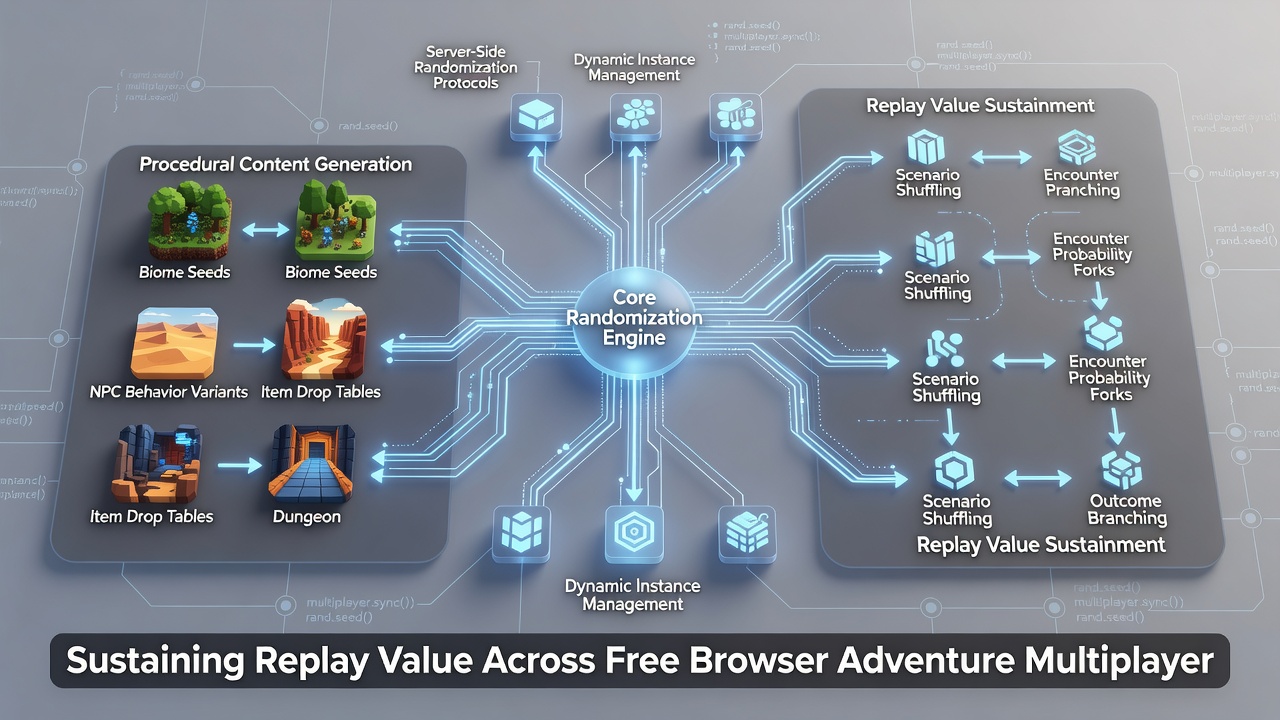
Replay Value Through Controlled Variability
Replay value emerges from the balance between consistency and novelty that server-side systems enforce. Procedural elements refresh at session start or upon milestone completions, guided by parameters that account for group size and historical play data aggregated anonymously. According to findings published by the Interactive Games and Entertainment Association in Australia, setups employing these protocols report higher retention rates compared to static content models because players encounter fresh configurations each time they reconnect. The server maintains logs of prior seeds to avoid exact repeats within short windows, yet preserves thematic coherence across adventures so that distributed groups can develop shared strategies adaptable to new variables.
Take one development team that implemented tiered randomization layers where basic terrain shifts occur frequently while major plot divergences trigger less often. This structure allows browser clients to load assets efficiently while the server manages complexity, resulting in sustained interest among players who participate across multiple time slots. Evidence from similar implementations shows reduced drop-off after initial sessions because uncertainty persists without overwhelming coordination demands on remote participants.
Technical Challenges and Mitigation Strategies
Network variability poses ongoing challenges for these protocols since packet loss or desynchronization can disrupt randomized event timing across distributed groups. Developers counter this through authoritative server models that resolve conflicts by prioritizing the central state and broadcasting corrections. Studies from the European Commission's digital innovation programs have documented how checksum validations integrated with randomization outputs maintain integrity during high-traffic periods. Furthermore, adaptive buffering techniques help align player actions with server-generated changes, preserving the illusion of seamless adventure progression even when connections fluctuate.
Security considerations extend to protecting the randomization engine itself from reverse engineering attempts. Obfuscation methods and periodic key rotations ensure that external observers cannot anticipate outcomes based on observable traffic patterns. Industry analyses indicate that free browser setups benefit particularly from these safeguards because they operate without paid gatekeeping mechanisms that might otherwise deter broad participation.
Conclusion
Server-side randomization protocols continue to underpin replay value in free browser adventure multiplayer setups by delivering controlled variability to distributed player groups. Through centralized generation, efficient state management, and ongoing refinements, these systems support repeated engagement without compromising accessibility or fairness. Data compiled by various research bodies demonstrates measurable impacts on session duration and return rates, positioning such approaches as foundational elements within the evolving landscape of browser-based multiplayer design.